Platomics announces new collaborations Read the Press Releases


Is ISO 15189 accreditation enough under IVDR?
If your laboratory makes and uses its own tests, the IVDR requires compliance with EN ISO 15189, or with national provisions where they apply, but that is not enough. It is one of nine conditions in Article 5(5), and the European guidance on in-house devices says that ISO 15189 compliance on its own is not an appropriate quality management system for making them.
[…] as the manufacturing process of a device and the compliance to the relevant requirements of Annex I is not in the scope of this standard, compliance with EN ISO 15189 alone does not constitute an appropriate QMS for the manufacture of in-house IVDs.
Source: MDCG 2023-1, Guidance on the health institution exemption, section 3.5.2, January 2023
That does not make accreditation less valuable. An ISO 15189 system gives you established procedures, records and a habit of review, and several of the other conditions build on them. The question is where it stops.
Dates at a glance. Annex I and point (a) have applied since 26 May 2022. Points (b), (c) and (e) to (i) have applied since 26 May 2024. Point (d) applies from 31 December 2030.
What ISO 15189 covers, and what it does not
Article 5(5) sets nine conditions, labelled (a) to (i), and each in-house test must also meet the general safety and performance requirements in Annex I. This is how far an ISO 15189 system takes you.
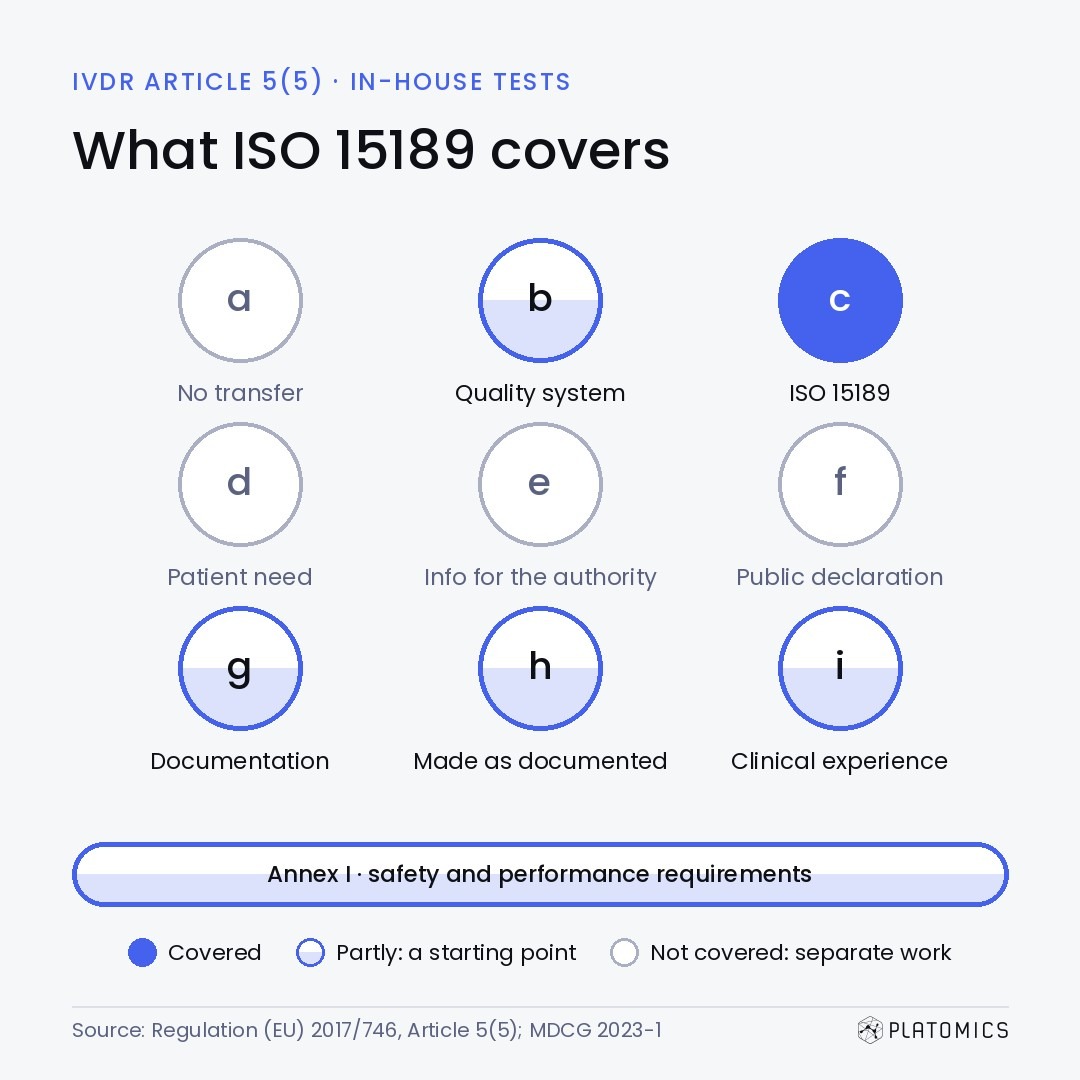
Nine conditions of IVDR Article 5(5): ISO 15189 covers point (c), partly helps with (b), (g), (h), (i) and Annex I, and does not cover (a), (d), (e) and (f)]
Covered by ISO 15189
- Laboratory standard (point c). The laboratory complies with EN ISO 15189, or with national provisions where they apply. Accreditation is evidence of compliance for the examinations in its scope.
Partly covered: your system is a starting point
- Quality management system (point b). It must also cover how each test is designed and made, not only how it is run.
- Documentation (point g). Validation records help, but the documentation asked for is broader: facility, manufacturing process, design, performance data and intended purpose. Required for class D tests; your country may extend it to other classes.
- Made as documented (point h). Document control helps; it has to reach the documentation of each test.
- Experience from clinical use (point i). Nonconformity and improvement processes help, if they capture experience with each test as a device.
- Annex I requirements. Validation evidence helps; each test still needs its own assessment, requirement by requirement.
Not covered: separate work
- No transfer (point a). The test is not transferred to another legal entity.
- Patient need (point d). A documented reason why no equivalent device on the market meets the target patient group’s needs, or not at the right level of performance. Applies from 31 December 2030.
- Information for the authority (point e). On request, information on the use of the tests, including why they are made, modified and used.
- Public declaration (point f). A public declaration that names the institution, identifies the tests and states that they meet Annex I, with a reasoned justification for any requirement not fully met.
Compliance, not necessarily accreditation
Point (c) asks for compliance with EN ISO 15189, or with national provisions where they apply, including national provisions on accreditation. The IVDR does not require every laboratory to be accredited: MDCG 2023-1 says compliance “may be understood as accreditation to the standard or other means of compliance”. National law may still require accreditation.
- Accreditation covers the examinations in your accreditation scope. It does not cover designing and making a test as a device: this is where ISO 15189 stops.
- Not every in-house application may fall under an accreditation scheme. Check with your accreditation body and your national competent authority how each of your in-house tests is covered.
What to do next
- List every test you make or modify yourself, with its intended purpose and risk class.
- Make sure your quality management system covers making the tests, not only running them. Start from your ISO 15189 system and extend it to design, manufacture, risk management and the Annex I requirements.
- Build the evidence for each test before you write any declaration: the technical documentation, risk management and the validation of its performance.
- Check each test against Annex I, requirement by requirement. PlatoX® includes a checklist of the general safety and performance requirements (GSPR) for this.
- Draw up and publish the declaration required by point (f).
- Keep the evidence for each test, so you can answer a request from your competent authority under point (e) quickly.
What may change
In December 2025 the European Commission proposed changes to the IVDR (COM(2025) 1023). For in-house tests, the proposal would, among other things, delete point (d) and remove some documentation obligations for laboratories accredited to EN ISO 15189.
It is still a proposal. In October 2026 neither the European Parliament nor the Council had adopted its position (procedure 2025/0404(COD)). Until a new text is adopted, the current Article 5(5) applies, including point (d) from 31 December 2030. Keep an eye on the proposal before you start a market search for every test. More on the proposal: IVDR 2.0 and Article 5(5): what could change for in-house IVDs.
Prefer to watch? Our webinar Regulatory ratatouille in the lab: IVDR, ISO 15189 and co. covers the same questions in 38 minutes, in English, German and French.
PlatoX® guides your laboratory through these conditions one test at a time and keeps each answer next to its evidence.
Sources
- Regulation (EU) 2017/746, consolidated text of 10 January 2025, Article 5(5)
- Regulation (EU) 2024/1860, which moved the date of point (d) to 31 December 2030
- MDCG 2023-1, Guidance on the health institution exemption, January 2023, section 3.5.2
- European Commission, proposal COM(2025) 1023 of 16 December 2025
- European Parliament, Legislative Observatory, procedure 2025/0404(COD)
* Disclaimer: We have compiled the above information to the best of our knowledge, yet our blog entries do not constitute expert advice and cannot substitute your own examination of the legal situation applicable to you and your institution.